TR Constructions LLC | Altadena Rebuild Resource Series
Published February 2026 | Based on information shared at the Altadena Solutions Summit
The TR Constructions team recently attended the Altadena Solutions Summit, a community event where experts shared critical information for families rebuilding after the Eaton Fire. We believe every homeowner deserves access to this information, whether or not they were able to attend. Below is a summary of key takeaways from one of the summit panels. This is educational information only and should not be considered legal, financial, or tax advice. Please consult with licensed professionals for guidance specific to your situation.
The Altadena Solutions Summit featured a panel specifically focused on alternative construction methods. For homeowners who want to rebuild faster or are looking for cost savings, understanding the differences between modular, prefabricated, and panelized construction is important. Three companies presented their approaches, and the panel dispelled several common myths.
What Are the Different Methods?
Modular / Manufactured Homes
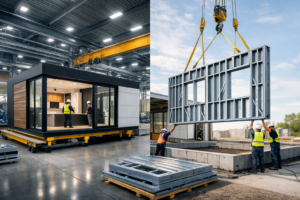
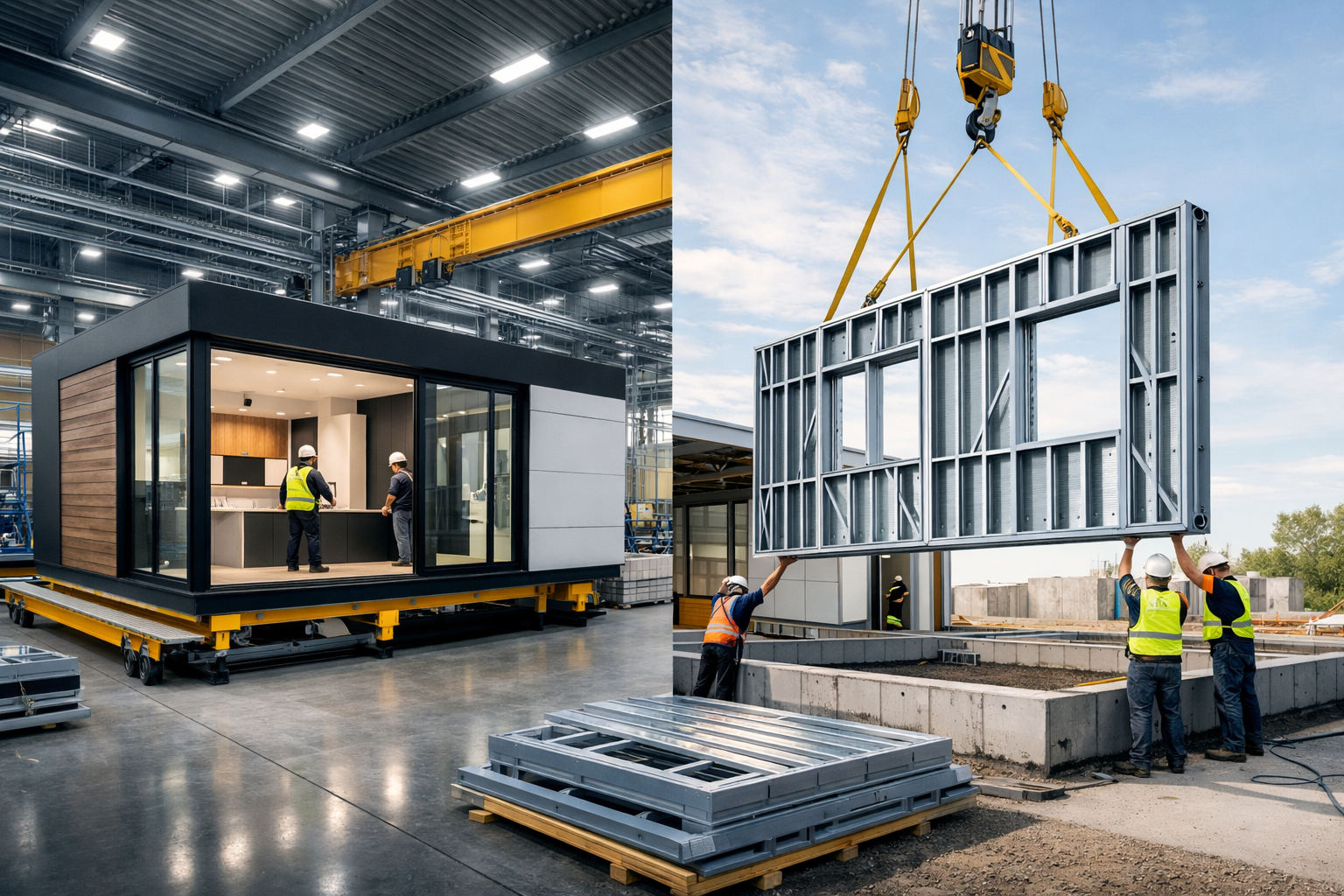
A modular or manufactured home is built almost entirely in a factory. The kitchen, bathrooms, flooring, cabinetry, and finishes are all installed before the home leaves the facility. The completed home (or sections of it) is then transported to your lot on a truck and placed onto a permanent concrete foundation.
One company at the summit (Home Gallery) described their process as delivering full custom designs and pricing within 48 hours of first meeting. From there, homeowners spend roughly 30 days selecting every detail, down to outlet placement. Once the design is locked in, the home is built in the factory and delivered.
Another company (Villa) described a catalog-based approach with pre-designed models (two-bedroom, three-bedroom, and larger options) that can be customized with different finishes, colors, flooring, and exterior materials. Their homes have already gone through county plan approval, which can save significant time.
Panelized Construction
Panelized construction is different. Instead of building the entire home off site, only the structural components are manufactured in a factory. In the example presented at the summit (Light Mods), light gauge steel panels for walls, roofing, and flooring are fabricated in a factory, trucked to the site, and erected with a crane in a matter of days. Once the panels are up, traditional trades (plumbing, electrical, HVAC) come in and complete the home on site.
The benefit of panelized construction is that you still have full customization over your interior finishes, layouts, and design. It simply replaces the framing method with a faster, fire-resistant alternative.
Myth Busting: Key Questions Answered
Will my home appraise differently?
No. This was one of the most emphasized points on the panel. When a manufactured or modular home is placed on a permanent concrete foundation (called an A-433 foundation), it is legally registered as a single-family dwelling. It becomes real property. It is federally required to appraise the same as traditionally built homes in the surrounding area. Your mortgage, your insurance, and your home’s market value are treated identically to your neighbor’s stick-built home.
How fast can these homes actually be built?
The timelines shared at the summit were significantly faster than traditional construction. Villa described a 60-day on-site timeline for single-section homes (from foundation ready to keys in hand) and 60 to 90 days for multi-section homes. These timelines do not include foundation work or permitting, which happen in advance, but the on-site construction portion is dramatically compressed.
For panelized construction, the wall erection can happen in a couple of days. However, because the interior trades (plumbing, electrical, HVAC) still happen on site, the overall timeline is longer than a fully manufactured home but still shorter than a traditional stick build because foundation and panel fabrication happen simultaneously.
Do I still get to choose my finishes and design?
Yes, across all three methods. Manufactured and modular home builders offer extensive customization in windows, countertops, cabinetry, flooring, and exterior materials. The key difference is that you make these choices earlier in the process because once construction begins in the factory, changes are difficult. Panelized construction offers the same level of customization as any traditional build because only the structural frame comes from the factory.
Is the insurance the same?
Yes. Once on a permanent foundation, these homes are insured like any other single-family residence.
Is the mortgage the same?
Yes. Once classified as real property on a permanent foundation, standard mortgage products apply.
Why Does Fire Resistance Matter?
The panelized option using light gauge steel framing drew particular attention because of its fire-resistant properties. One home built with this method in 2022 (an ADU at 480 West Palm in Altadena) survived the Eaton Fire while the main wood-framed house was destroyed. The family has since chosen to rebuild their main home using the same steel framing method.
Steel framing also eliminates concerns about mold, termites, and warping because it is not an organic material. For families rebuilding in a wildfire zone, these properties are worth considering.
How to Evaluate Your Options
The panel’s closing message was that off-site construction is one method among many. Every family’s situation is different. The important thing is to talk to multiple builders, understand what each approach offers, and make an informed decision based on your budget, your timeline, and the home you want to live in.
Several of the companies represented at the summit offer free feasibility studies. This means they will review your lot, your goals, and your budget at no cost to help you determine whether their approach is a fit.
TR Constructions offers both traditional and prefabricated construction approaches. If you would like to explore which method is right for your rebuild, call us at (626) 542-1609 to schedule a free consultation.
About TR Constructions
TR Constructions LLC is a fully licensed Class B General Contractor (CA License #926469) with over 26 years of experience in residential, commercial, and industrial construction. We are actively helping Altadena families navigate the rebuild process. If you have questions about rebuilding your home, call us at (626) 542-1609 or visit trconstructionsllc.com to schedule a free consultation.